Triply Cookware — Kadhai, Tawa, Frying Pan, Handi & More
34.28% OFF
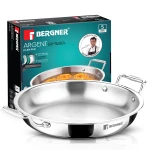
24% OFF
25.07% OFF
34.52% OFF
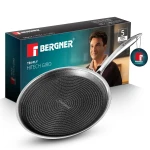
33.55% OFF
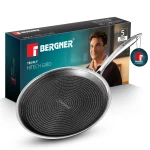
34.68% OFF
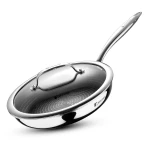
35.15% OFF
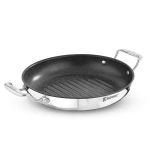
24.06% OFF
30.15% OFF
32.93% OFF
28.85% OFF
28.9% OFF

33.72% OFF

36.78% OFF

33.53% OFF

36.83% OFF

26.05% OFF

13.7% OFF
14.49% OFF
10.3% OFF
14.64% OFF
9.72% OFF
13.49% OFF
12.04% OFF
11.66% OFF
9.42% OFF
14.34% OFF
11.81% OFF
5.2% OFF
29.79% OFF
44.33% OFF

8.33% OFF

11.1% OFF

8.35% OFF

11.26% OFF

3.94% OFF

22.4% OFF

20.17% OFF

20.36% OFF

Triply Cookware — Kadhai, Tawa, Frying Pans, Handis, Patilas and Tadka Pans in Plain Triply Steel and Triply Non-Stick
Triply cookware has become the everyday choice for Indian kitchens that want stainless steel's safety and long life without the sticking and scorching of ordinary steel vessels. This page brings together more than eighty triply pieces available at GD Sons from Hawkins, Bergner, Stahl and Borosil, covering every vessel the Indian kitchen relies on: kadhais, tawas, frying pans, handis, patilas, saucepans and tadka pans. They come in two kinds of cooking surface, plain triply steel and triply with a non-stick surface. Every piece is built the same way underneath: food-grade stainless steel on the inside, an aluminium core in the middle, and magnetic stainless steel on the outside, bonded together through the base and up the walls. The aluminium spreads heat evenly, the inner steel keeps food from ever touching the aluminium, and the magnetic outer layer makes every piece work on induction as well as gas, electric and ceramic cooktops. The real decision is which cooking surface suits the dish, so that comes first.
Plain Triply or Triply Non-Stick — How to Choose and How to Cook on Each
Plain triply steel has a bare stainless steel cooking surface with no coating at all. It is the most durable and versatile surface you can cook on. It takes high heat, metal spatulas and vigorous scrubbing, never wears out, and is ideal for bhuna, tadka, deep frying, searing, browning onions, simmering gravies and cooking tomato- or tamarind-based dishes. It is the right surface for anyone who wants cookware that lasts decades with no coating to look after.
Triply non-stick adds a non-stick coating on top of the triply body, so food releases with very little oil and cleans off with a wipe. It is ideal for dosas, chillas, eggs, pancakes, cutlets, tikkis, parathas and low-oil cooking, where food would otherwise stick to bare steel. Because the triply body underneath still spreads heat evenly, non-stick triply pieces cook more evenly than thin aluminium non-stick pans.
Why food sticks to plain steel, and how to stop it. Food sticks to stainless steel when it goes into a pan that isn't hot enough: the cold food grips the surface before a cooking layer can form. The fix is simple. Heat the empty triply pan on a medium flame for a minute or two, then try the water-droplet test: sprinkle a few drops of water into the pan. If they sizzle and evaporate instantly, the pan isn't ready yet. When the drops form little balls that skate across the surface, the pan is at the right temperature. Now add your oil, let it warm for a few seconds, and add the food. Let it sit undisturbed until it forms a crust and releases naturally. Trying to move it too early is what causes tearing. Done this way, plain triply is surprisingly low-stick, even for eggs and dosa. Because triply spreads heat so well, medium flame is almost always enough; high flame is rarely needed and makes sticking more likely.
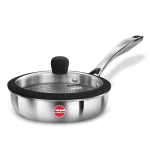
Honeycomb non-stick explained. Several non-stick pieces here, including Hawkins' honeycomb range and the Bergner Hitech Giro, use a honeycomb surface. The cooking surface is a grid of raised stainless steel ridges, with the non-stick coating set into the hollows between them. Spatulas, turners and even metal utensils glide over the steel ridges and don't scrape the coating, which protects it from the scratching that wears out ordinary non-stick. You get easy release and low-oil cooking with a surface that lasts much longer.
Reinforced non-stick. The Stahl Artisan Schild dosa tawas use a PTFE non-stick coating reinforced with PEEK, a very tough engineering material that makes the coating resist scratching, flaking and everyday wear far better than standard non-stick. The coating is PFOA-free and BPA-free, and meets food-safety standards including US FDA, German LFGB and Indian BIS.
Rainbow tints and white spots. Plain triply steel sometimes shows a faint rainbow or golden tint after high-heat cooking. This is a harmless heat tint in the steel's surface layer and does not affect cooking. White, cloudy spots inside are mineral deposits from hard water. Both wipe off with a little diluted vinegar or lemon juice. Neither is a sign of damage.
Caring for triply. Let cookware cool before washing, as plunging a hot pan into cold water can warp any metal. Wash plain triply with dishwashing liquid and a scrubber; it handles firm scrubbing well. For stubborn burnt-on food, soak with warm water and a little baking soda before scrubbing. For non-stick triply, use a soft sponge rather than steel wool, avoid heating it empty for long periods, and cook on low to medium heat. Dry everything after washing to keep the finish at its best.
Triply Kadhai — Plain Steel and Non-Stick
The kadhai is the busiest vessel in an Indian kitchen, used for sabzi, gravies, deep frying, halwa and stir-fries, and the triply kadhai range here is the widest on the page.
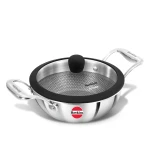
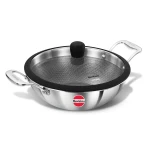
Hawkins triply kadhais come in several families. The standard range with glass lids is available in 1.5 litres and 2.5 litres (SSD) and 4 and 5 litres (SSK). The glass lid lets you watch the food without lifting it. The Pro range comes with stainless steel lids in 1.5, 2.5, 3.5, 5 and 6 litres. The 6 litre is one of the largest triply kadhais on the page, suited to big families and festival cooking. The Hawkins Olive triply kadhai is a 2.5 litre design variant with a glass lid. For low-oil cooking, the Hawkins honeycomb non-stick kadhai (NSDK) comes in 2.5 litres with a glass lid, and the Pro non-stick kadhai (PSNK) in 1.5 and 3.5 litres.
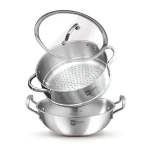
Bergner Girisha triply kadhais come with glass lids in five sizes: 20 cm (1.7 litres), 22 cm (2.3 litres), 24 cm (3 litres), 26 cm (3.6 litres) and 30 cm (5.2 litres). The Bergner Revanth Multi Kadhai (24 cm) adds a steamer insert, so the same kadhai makes idli, momos and dhokla.
Stahl Artisan triply kadhais, with steel lids and a brushed finish good enough to serve from, come in 16, 20, 22, 24, 26, 28 and 30 cm. The 16 cm is ideal for tadka or a single portion, and the 30 cm for large batches.
The Stahl Artisan Tasla, in 20 cm and 24 cm with a steel lid, is a kadhai without side handles. It has a wider, shallower shape that suits halwa, kheer and any dish needing constant stirring across a broad surface.
Borosil triply kadhais come with lids in closely spaced capacities of 1.6, 2.1, 2.7, 3.6, 4.6 and 5.5 litres, making it easy to find exactly the right size.
Triply Tawa — Roti, Paratha and Dosa
A triply tawa stays flat, heats evenly from the centre to the edge, and holds steady heat, which is what rotis, parathas and dosas need to cook evenly.
Plain triply tawas: the Hawkins triply tawa (SSTV) in 22, 24 and 26 cm is ideal for rotis, phulkas and parathas, and lasts for decades.
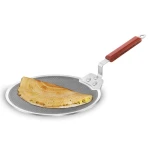
Honeycomb non-stick tawas: the Hawkins honeycomb non-stick tawa comes in 24 cm and 26 cm (NSPT), and the Hawkins Pro honeycomb non-stick flat tawa in 26 cm (PSNFT26). Both are good for low-oil parathas, chillas and uttapam, and the steel ridges protect the coating even when you use a metal turner.
Dosa tawas: the Hawkins triply non-stick dosa tawa comes in 28 cm (honeycomb, NSDT28) and 30 cm (NSDT30). The Bergner Hitech Giro honeycomb non-stick dosa tawa comes in 28 and 30 cm. The Stahl Artisan Schild dosa tawa, with its PEEK-reinforced non-stick, also comes in 28 and 30 cm. The 28 cm suits home-size dosas and uttapam, while the 30 cm gives room for larger, restaurant-style dosas.
Triply Frying Pans — Plain Steel and Non-Stick
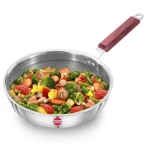
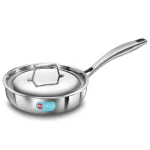
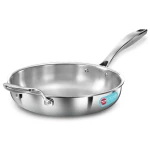
Frying pans handle eggs, cutlets, tikkis, paneer, shallow frying, sautéed vegetables and quick stir-fries.
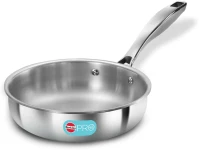
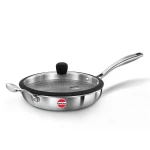
Hawkins plain triply frying pans come in the standard range with glass lids, in 22 cm and 24 cm (SSF), and the Pro range in 18 cm, 22 cm and 26 cm, each available with or without a steel lid (PSF). The 18 cm is handy for one egg or a single portion, and the 26 cm for family-size cooking. The Hawkins Olive triply frying pan comes in 22 cm with a glass lid.
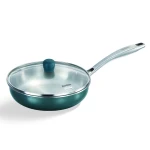
Hawkins non-stick triply frying pans include the honeycomb non-stick frying pan in 22 cm, with or without a glass lid (NSF22 and NSF22G), and the Pro non-stick frying pan in 18 cm and 26 cm with glass lids (PSNF).
The Bergner Hitech Giro frypan (24 cm) has a honeycomb non-stick surface safe with metal utensils. The Bergner triply non-stick grill pan (26 cm) has raised ridges that give food char lines and let fat drain away, ideal for paneer tikka, grilled vegetables, sandwiches and kebabs. The Stahl Artisan fry pan (24 cm) comes with a steel lid in plain triply.
Triply Patila, Saucepan, Handi and Lagdi
These deeper vessels are for boiling, simmering, dal, rice, milk and one-pot meals.
A patila is a straight-sided pot used for boiling milk, making tea, cooking dal and boiling vegetables. The Hawkins triply patila comes in 1.5, 2 and 2.5 litres. Triply construction spreads heat evenly, so milk is less likely to catch and burn at the base.
A saucepan is a smaller pot with a long handle, for milk, tea, sauces, oats, porridge and reheating. Options include the Hawkins Pro triply saucepan (1.5 litres, steel lid), the Stahl Artisan saucepan (16 cm), and the Stahl Artisan belly saucepan (18 cm). The belly saucepan's rounded sides make whisking and stirring easier and help prevent lumps in custards and sauces.
A handi is a rounded, belly-shaped pot traditionally used for dal, curries, rice and biryani, and often brought straight to the table. The Hawkins triply Cook-n-Serve handi comes with a glass lid in 2, 3, 4 and 5 litres. The Stahl biryani handi (24 cm) is shaped for layered dum cooking, with heat travelling evenly up the sides. The Bergner Ankush rice handi comes in 2.2 litres (16 cm), 3.1 litres (18 cm) and a large 9.5 litres (28 cm) for biryani and rice for gatherings.
A lagdi is a wide, moderately deep pot that sits between a kadhai and a patila. It is wide enough for food to spread and cook evenly, and deep enough to hold gravies and liquids. The Bergner Argent Lagdi comes in 22 cm and 24 cm with a steel lid and a measurement scale marked inside, so you can measure water or milk directly in the pot.
Triply Tadka Pans — 1.5 and 2.5 Cups
A tadka pan is a small, deep pan with a long handle, used for tempering: heating ghee or oil and crackling mustard seeds, cumin, curry leaves, dried red chillies, hing and garlic, then pouring the sizzling tadka over dal, sambar, raita, khichdi or poha. Its small size heats the oil fast, and its long handle keeps your hand away from the heat while pouring. The Hawkins triply tadka pan comes in 1.5 cups and 2.5 cups. The triply base spreads heat so spices crackle evenly instead of burning in one spot, and the bare steel surface is ideal for high-heat tempering. It is also handy for melting butter, warming a little milk, or roasting a spoonful of spices.
Bergner Balaji Coffee Warmer — 10 cm and 12 cm
The Balaji coffee warmer is a small, deep triply vessel with a handle, made for warming milk and decoction for South Indian filter coffee and pouring neatly. It is just as useful for heating a cup of milk or chai, melting ghee, warming small quantities, or making a quick tadka. The 10 cm suits one or two cups, and the 12 cm a few more.
Triply Cookware Sets — Hawkins Trinity
For setting up a kitchen in one go, the Hawkins Trinity triply set combines the three most-used pieces, a kadhai, a tawa and a frying pan, in matching triply steel. It comes in a 22 cm set for smaller households and a 26 cm set for larger families. A matching set gives you consistent performance and finish across your everyday cookware.
Which Triply Pieces Suit Your Kitchen?
Everyday North Indian cooking: a plain triply kadhai, a triply roti tawa, a patila for milk and tea, and a tadka pan. South Indian cooking: a non-stick triply dosa tawa, a rice handi, a kadhai with steamer for idli, and the coffee warmer. Low-oil and health-focused cooking: honeycomb or reinforced non-stick tawas, frying pans and kadhais. Large families and festival cooking: a 5 or 6 litre kadhai, a 30 cm dosa tawa, and the 9.5 litre rice handi. Small households and students: a 1.5 litre kadhai, an 18 cm frying pan, a small saucepan and a tadka pan. Induction kitchens: every piece on this page works on induction.
Triply Cookware for Weddings and Griha Pravesh
Triply cookware makes a lasting wedding or Griha Pravesh gift, because it is used every day and lasts for decades. A Hawkins Trinity set gives a newly married couple the three essential pieces in one gift. A pair of triply kadhais in two sizes, or a kadhai with a matching tawa and frying pan, makes a complete everyday cooking set. For Griha Pravesh, a triply patila or handi carries special meaning, since boiling milk in a new home is a cherished tradition. A triply rice handi also makes a thoughtful gift for a family that cooks generously. Every piece works on gas and induction, so it suits whatever cooktop the new home has.
Buy Triply Cookware at GD Sons — Genuine Products, Pan-India Delivery
GD Sons has been Varanasi's trusted kitchenware store since 1970. All triply cookware listed here is genuine, from Hawkins, Bergner, Stahl and Borosil, sold with pan-India home delivery. Varanasi customers can visit the flagship store at Sigra to compare plain and non-stick surfaces, feel the weight of different pieces, and see the honeycomb surface up close before buying. For gifting sets, bulk orders or any questions, our team is reachable by phone or WhatsApp.