Choose the Right LPG Gas Stove
An LPG gas stove looks like a simple purchase, but the moment you walk into a store or open a website, the questions pile up. How many burners? Glass top or steel? Table-top or a built-in HOB? And how much should you actually spend? Most people end up choosing on looks or price alone, and then live with a stove that doesn't suit how they cook. This guide walks through the four decisions that matter, plus a few things buyers almost always miss. It's the written version of our detailed podcast on the subject, so you can read, watch, or both.
See the full range at GD Sons
You can explore our complete LPG gas stove section on gdsons.co.in, where every product is described in detail and you can order online — or visit our store. If you have any questions, drop them in the comments, and we'll keep making videos on pressure cookers, bottles and more, so do subscribe to stay connected.
Girdhar Das & Sons has served kitchens for over 55 years. As an authorised dealer based at our Sigra flagship in Varanasi, we stock genuine products at competitive prices, with pan-India home delivery and support by phone or WhatsApp. Find us on Google or reach out any time — we're happy to help you pick the right stove for your kitchen.
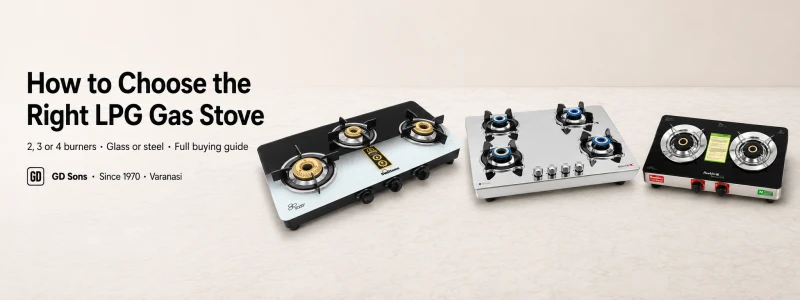
How many burners: 2, 3 or 4?
The first decision is size, and it comes down to your family and how you cook. Today three sizes are common — two burner, three burner and four burner — along with a single-burner option for specific uses. (For context, before the 1990s most homes ran everything on a simple two-burner stove; the larger sizes came later.)
Two burner
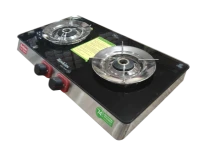
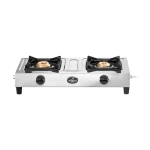
For a small family, a two-burner stove is more than enough. It's compact, affordable and covers everyday cooking without fuss. If two pots at a time is all you ever use, there's no reason to pay for more.
Three burner — the highest seller
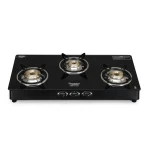
The three-burner stove is the most popular size, and for good reason. A well-built three-burner gives you three different flame sizes — one small, one medium and one jumbo (the large burner) — so you can match the flame to the pot instead of fighting it. That flexibility is what makes it the most effective everyday stove.
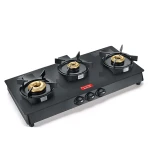
One thing to watch: some low-priced three-burner models drop the jumbo burner to hit a lower cost. You end up with two small and one medium, or two medium burners, often on a smaller frame. If you specifically want the three flame sizes, check the burner layout before you buy rather than going by price alone. Three-burner stoves generally start around ₹5,000–₹6,000, with no real upper limit once you move into designer models.
Four burner — square vs pyramid
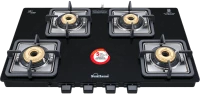
Four-burner stoves come in two shapes. The traditional square layout puts two burners at the back and two at the front. It works, but if you're moving straight from a two-burner stove to a four-burner square, expect an adjustment period — you're used to handling two pots, and four pots close together need a bit of technique so utensils don't knock into each other. If you don't use all four, that's wasted space; if you do, there's a small learning curve.
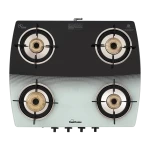
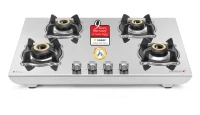
The newer and increasingly popular layout is the pyramid (inverted-V) shape: the two front burners sit further apart and the two back burners sit closer together. It takes a little more space but manages that space well and is genuinely effective for a busy kitchen. Four-burner stoves usually start at around ₹10,000–₹11,000. If you're building a proper new kitchen, it's a better choice than a two- or three-burner and comes in plenty of designs.
Single burner
A single-burner stove exists for particular needs — a separate stove for fasting or Navratri cooking that families like to keep apart, a very small household, or a single person living alone. It's cheaper, but it's a special-purpose choice, not a main-kitchen stove.
14.55% OFF
34.67% OFF
Surface: glass, steel or single-sheet steel
Once the size is settled, the surface is the next big decision. There are two broad families — glass and steel — and a newer steel variant worth knowing about.
Glass top
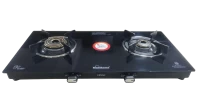
Glass-top stoves arrived around 1999–2000 and have dominated sales for the last two decades. They aren't ordinary glass — they use toughened glass, which is hard enough that dropped items usually won't crack it. They're very easy to clean (one wipe and the surface is spotless), simple to maintain, and typically carry a decent warranty of two to five years depending on the model. If you're building a new kitchen and have the budget, a glass-top LPG stove is the usual pick.
One important warning: a glass-top stove is not meant for a gas tandoor — the kind used to make baati or naan directly over the flame. That utensil locks heat into one small area, so one part of the glass gets very hot while the rest stays cool, and the surface can crack. Most stoves state this in the instructions. Any other pot or pan in the world is fine; the gas tandoor is the exception. If baati, naan or a gas tandoor is a regular part of your cooking, a glass top isn't the right surface for you.
Traditional steel
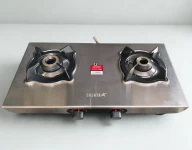
Traditional steel cook tops are built by joining two or three steel sheets. The design is basic and simple, but they run well and remain the highest-selling stoves in the entry segment. The trade-off is that designer options aren't really available in this style — so if you've spent well on your kitchen and want a stove that looks the part, plain steel may feel too basic.
Single-sheet steel — the newer option
The newer arrival is the single-sheet steel cook top, where the entire top is made from one continuous sheet. Older steel tops were around 0.8 mm and felt light; these are built from thicker 1.2 mm or, most popularly, 2 mm steel. The result is heavy, strong, sturdy, good-looking and long-lasting — much of what you want in a product. Models like Hindware's Art and Sujata's Sterno, Robusto and Majestic sit in this category (Sujata alone offers three). These are among the most popular stoves right now.
So decide your surface up front. Tight budget and don't care about design? Traditional steel, available in two, three and four burners and in round or straight models. Want the established favourite? Glass top. Want the newer, tougher option? The 2 mm single-sheet steel stoves.
28.9% OFF
33.86% OFF
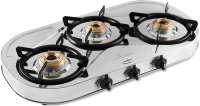
Table-top vs HOB
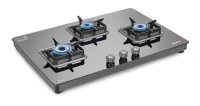
This is a debate we've had for years. A table-top stove is the traditional one you place on your platform — connect the gas pipe and it's ready. A HOB, by contrast, needs the platform to be cut so the stove sits flush inside it, level with the slab.
A HOB looks elegant and carries a certain status, but honestly, beyond appearance there's little special about it — and it comes with real drawbacks. It's expensive, and the maintenance is tough. Surface cleaning is easy enough, but milk, water and spills find their way underneath and settle there; cleaning that properly means removing the entire stove, which isn't easy. Because the unit is packed in from below, the burners also get less air, which lowers flame intensity — so it can feel like your food is cooking slower. The burners themselves are high quality, but they often struggle with the demands of Indian cooking and can fail faster, and a single replacement burner can cost nearly as much as a whole table-top stove. In our experience, most people who insisted on a HOB ended up regretting the maintenance. Our recommendation is straightforward: go for a table-top cook top and avoid the HOB. If you're set on one, it's available — but go in with eyes open.
12.47% OFF

37.27% OFF
Budget: how much should you spend?
Budget is worth thinking through before you shop, because it keeps you from over- or under-buying. Stoves can start as low as ₹1,500–₹2,000, and branded ones rarely go below ₹2,000. A ₹2,000 stove is perfectly good — nothing wrong with it — just simple, small and steel.
As you go up: a glass-top stove from a good brand such as Sunflame or Hindware won't come below roughly ₹4,000–₹5,000. A good three-burner glass top typically runs between ₹7,500 and ₹12,000–₹13,000, with three burner sizes and a solid warranty. Four-burner and single-sheet steel stoves like the Robusto sit higher, around ₹17,000–₹18,000.
The practical advice: fix a budget and shop within it. If you've planned for ₹5,000, don't force yourself into a ₹10,000 stove — ultimately a stove is for cooking, and after two or three years the design differences fade anyway. That said, if you're building a large new kitchen and can stretch to ₹10,000–₹12,000, there are genuinely good stoves in that range that complete the look of the kitchen.
22.15% OFF
24.46% OFF

Three things buyers almost always miss
The gas valve position
The gas valve connects in one of two ways. On traditional stoves it sits on the side — left or right — and can't be changed. On most stoves above roughly ₹4,000, the valve sits at the rear and rotates, so you can change its direction freely. Wherever possible, go for the rotating rear valve: it gives you the freedom to bring the gas pipe in from any side.
Moving from LPG to PNG
If you're on an LPG cylinder now but expect to switch to PNG later, there's no need to worry. The same stove works on both. Moving to PNG simply needs a small clip fitted at the back that adjusts the gas pressure, and the stove runs fine on PNG. So if anyone tells you you'll have to buy a different stove for PNG, don't believe it — just call the service centre of your stove's brand, or have the simple clip fitted, and the stove will work properly.
The warranty trap
Companies now advertise warranties of 2, 5, 9, even 15 years. But a warranty is only as good as the service behind it. Before you're impressed by the number, confirm that the stove's service centre actually operates in your city. A nine-year warranty is worthless if the service centre disappears from your city after three years. So trust the dealer you're buying from more than the printed warranty — a good dealer looks after the stove for as long as you own it, and service can usually be arranged somewhere regardless. Buy for quality, for the dealer, and for a brand with a long track record, rather than for a warranty number alone.
24.03% OFF
32.73% OFF
Which brand should you choose?
At GD Sons we stock three brands for gas stoves — Sunflame, Hindware and Sujata.
Sunflame is a long-established brand whose stoves are still among the most popular, with dependable service. Hindware is relatively newer but its service is very good and its models are genuinely attractive. Sujata is the newest of the three, only a year or two old in this space, but its products are sturdy and robust. If you're asking which is best right now, our view is that Sujata's stoves are the strongest pick at the moment — a little more robust internally, good response, and very few complaints. That said, quality across these brands is broadly similar, so a lot comes down to personal preference.
39.88% OFF

24.92% OFF
Frequently asked questions
Can I use a gas tandoor or make baati and naan on a glass-top gas stove?
No. A gas tandoor concentrates heat in one spot, which can crack a glass top — most stoves warn against it in the instructions. If baati, naan or a gas tandoor is a regular part of your cooking, choose a steel cook top instead.
Will the same LPG gas stove work with PNG?
Yes. The same stove runs on both LPG and PNG. Switching to PNG only needs a small clip fitted at the back to adjust the pressure — you don't need to buy a new stove.
How many burners should I choose — 2, 3 or 4?
A two-burner is plenty for a small family. A three-burner is the highest-selling and most flexible option, with small, medium and jumbo flames. Choose a four-burner mainly for a larger kitchen, and ideally don't jump straight from two burners to four without expecting a short adjustment.
Is a glass-top or steel gas stove better?
Glass tops are easy to clean and look good, and have led sales for two decades. Traditional steel is the budget-friendly workhorse. The newer 2 mm single-sheet steel stoves are the most durable modern option. The right one depends on your budget, your cooking and whether you use a gas tandoor.
How much does a good gas stove cost in India?
Branded stoves start around ₹2,000 for a simple steel model. A good glass-top three-burner typically costs ₹7,500–₹13,000, and heavier single-sheet steel or four-burner models run higher, around ₹17,000–₹18,000.
Should I buy a HOB or a table-top gas stove?
We recommend a table-top stove for most homes. A HOB looks elegant but is expensive and hard to maintain — spills settle underneath, cleaning means removing the whole unit, and replacement burners are costly.
Is a longer warranty always better?
Only if the service centre operates in your city. A long warranty is meaningless without local service, so buy from a trusted dealer and a brand with a solid track record rather than for the warranty number alone.
41.84% OFF
32.05% OFF